Choose the right spot on the bench first
Before you drill any holes, stand at the bench and work out how you actually use the space. A vice should sit where you can reach it from the front and the side, with enough room for long stock, files and saws. If it is too close to the wall, you will struggle with longer workpieces. If it sits too far out on the corner, the bench can flex under load.
For most small to medium workshops in Pinetown or Westmead, the best position is near the front edge of the bench, slightly off centre, so the jaws can open freely without hitting shelves or drawers. Leave enough clearance for the handle to turn without knocking against tools. If you often work on pipe, angle iron or timber, think about where the stock will overhang while you are clamping it.
- Keep the vice close to the front edge for better leverage.
- Allow space behind the fixed jaw for bolts and washers.
- Check that the handle can rotate through a full turn.
- Make sure the bench top is strong enough for repeated clamping force.
Match the vice size to the work you do
A small vice is fine for light repair work, but it will feel weak if you try to hold heavy steel sections or pull on stuck parts. A vice that is too large can dominate the bench and make everyday tasks awkward. Think about the sizes you handle most often. For many trade workshops, a medium vice is the practical choice because it balances grip, weight and bench space.
Look at jaw width, jaw opening and the thickness of the mounting base. A wider jaw gives more contact on flat material, while a deeper opening helps when you need to hold larger fittings. If you do electrical prep, light fabrication or garden equipment repair, you may want a quicker release and a smooth swivel base. For heavier work, a fixed base can feel more stable. In Durban humidity, a coated or protected finish will help, but you should still wipe the vice down after use and keep the screw lubricated. Rust starts slowly then bites hard.
- Light-duty bench work: compact vice with smaller jaws.
- General workshop use: medium vice with good jaw depth.
- Metal work and fabrication: heavier body with stronger mounting points.
- Frequent outdoor or coastal use: choose protection against corrosion and clean regularly.
Mark out the holes and drill cleanly
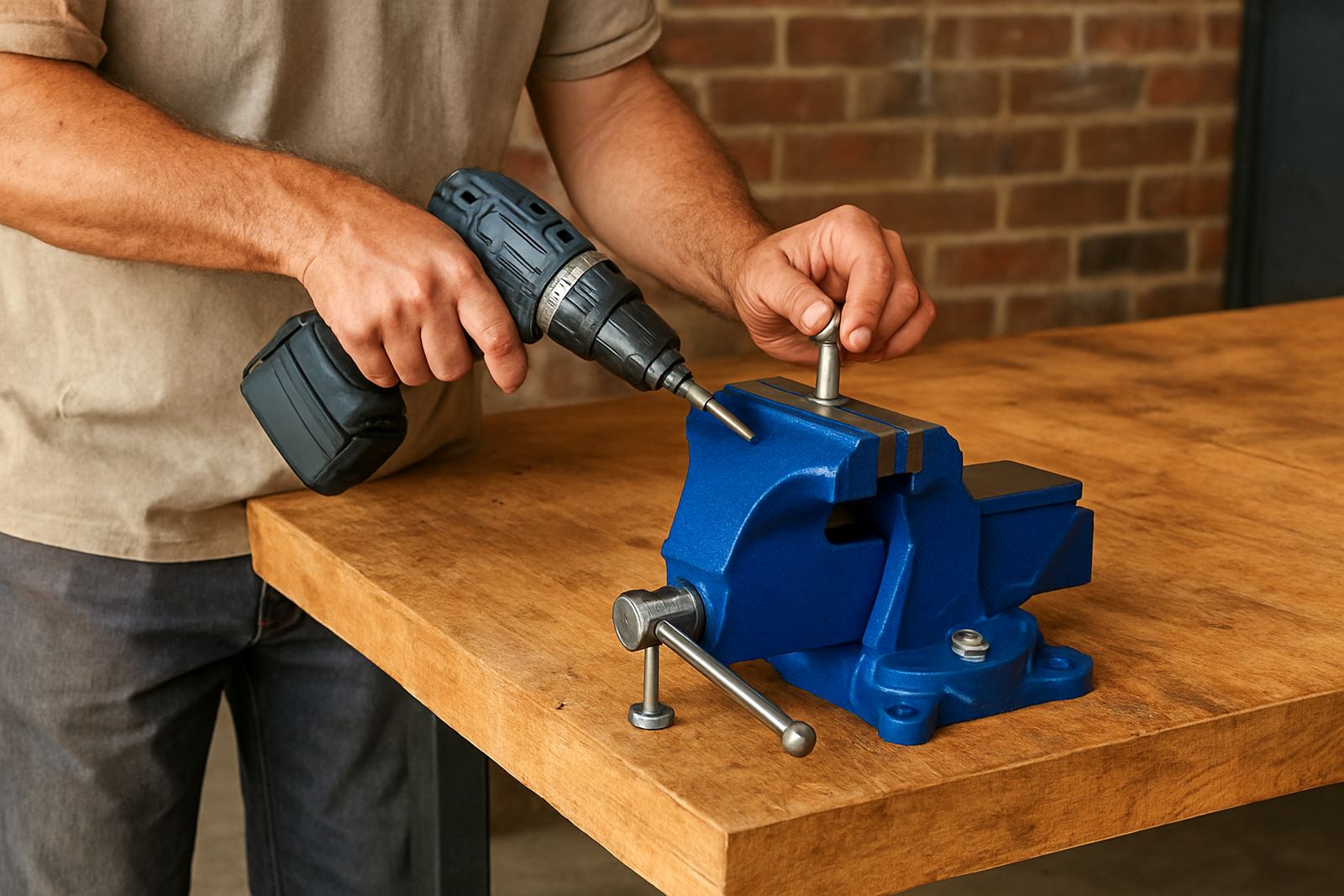
Once the position is right, use the base of the vice as a template and mark the fixing holes clearly. Double-check the orientation before drilling because a vice mounted the wrong way round becomes annoying fast. Use a centre punch to stop the drill bit wandering, then drill straight through the bench top at the correct size for the bolts.
If the bench top is timber, fit large washers or a backing plate underneath so the load spreads properly. On steel benches, use bolts and lock nuts that can handle vibration. Do not rely on wood screws for a vice that will see daily trade use. On some jobs, a small rubber mat or timber packing underneath can help level the base, but make sure it does not reduce stability. If your workshop has load-shedding stops and starts, people tend to rush the setup, and that is when holes go off-line. Take the extra minute.
- Measure twice before drilling.
- Use a punch to keep the drill bit on centre.
- Match bolt length to the bench thickness plus washers.
- Fit lock nuts or spring washers where needed.
Bolt it down so it does not shift under load
A bench vice must stay put when you lean on it, file a part or tighten a stubborn fastener. Tighten the bolts evenly and check that the vice base sits flat on the bench. If the base rocks even slightly, the vice will move over time and the holes will oval out. That makes the mounting weaker and the work less accurate.
After tightening, open and close the jaws a few times while watching the whole unit. There should be no wobble, no twist and no bench flex that feels unsafe. If the bench itself is light duty, reinforce it before you continue. Many smaller workshops in New Germany and Hillcrest work with limited floor space, so the bench gets used for everything from cutting wire to tapping threads. That is fine, but only if the vice is anchored properly. If you can move the vice by hand, it is not fixed well enough.
A good test is to grip a solid bar and pull from different angles. The vice should hold without shifting, and the bench should not rack or lift. If it does, stop and add stronger fixings or a brace under the top.
Set the height and working angle for comfort
The top of the jaws should sit at a height that lets you work without hunching your shoulders. If the vice is too low, your back takes the strain. If it is too high, you lose leverage and accuracy. For many workers, the jaws should sit roughly around elbow height, though the exact height depends on the tasks you do most often.
Think about the type of work too. For filing and detailed fitting, a comfortable upright stance matters. For sawing or bending, you may prefer a setup that gives a little more room for arm movement. In a small Pinetown workshop where one bench handles stripping, cutting and assembly, the vice often has to do more than one job. A sensible mounting height helps all of them. It sounds simple, but it makes the day less tiring.
- Use elbow height as a practical starting point.
- Allow space for long handles and saw strokes.
- Check that the vice handle turns without hitting your hip or the bench edge.
- Keep the work area clear so clamp pressure is not wasted.
Keep the vice clean, greased and ready for daily use
Once the vice is mounted, do not leave it to collect grinding dust, oil and moisture. Wipe the jaws after each shift and keep the screw threads lightly lubricated. This matters even more near the coast, where humidity can creep into the screw and base. If the jaws are smooth, fit jaw plates or protectors for softer materials so you do not scar the workpiece.
Check the mounting bolts every few weeks, especially on benches that take vibration from power tools. If you hear a click or feel movement, inspect it before the issue grows. Training staff on proper clamping is also worthwhile because a vice gets damaged when people use it as a hammering block or over-tighten soft parts. A clean vice is not just neater, it works better and lasts longer. That saves money over time, which is always useful in a busy trade shop.
For workshops around Durban North, Umhlanga and beyond, it is worth making vice checks part of the normal tool routine. That way the setup stays safe and ready, even when jobs are coming in fast.
A practical Durban example for a small trade bench
Picture a repair bench in Pinetown handling brackets, small pipe sections and general maintenance work. The operator needs to hold mild steel, trim bolts and file edges without chasing the piece across the top. A medium vice mounted near the front left corner gives enough room for long stock to hang clear while still leaving space for other tools on the bench. With proper bolting, a backing plate and regular cleaning, the setup stays reliable through daily use.
This is also where tool planning matters. If the vice is part of a new workshop setup, it should be chosen alongside the rest of the bench tools, not as an afterthought. The right mount point, the right size and the right fixings turn a basic vice into a tool that speeds up work instead of slowing it down. In practice, that means safer holding power, cleaner cuts and fewer resets during the day. Small details, but they matter.